
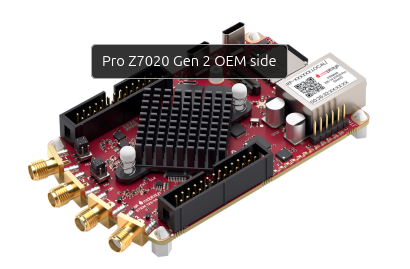
In a recent article dating from October 2025, CRT VALENTINCIC (Red Pitaya CTO) provides a very nice synthesis of why mastering FPGA tools is a game changer for photonic product development.
To explain things with a small chart, look at the following scheme. At the top is a simple representation of a classical lab experiment, off the shelf control boxes are hardly wired. This is the no-risk fast to go solution. However in the long run, this architecture, because of its rigidity, prevents efficient upgrade, maintainability of integration.
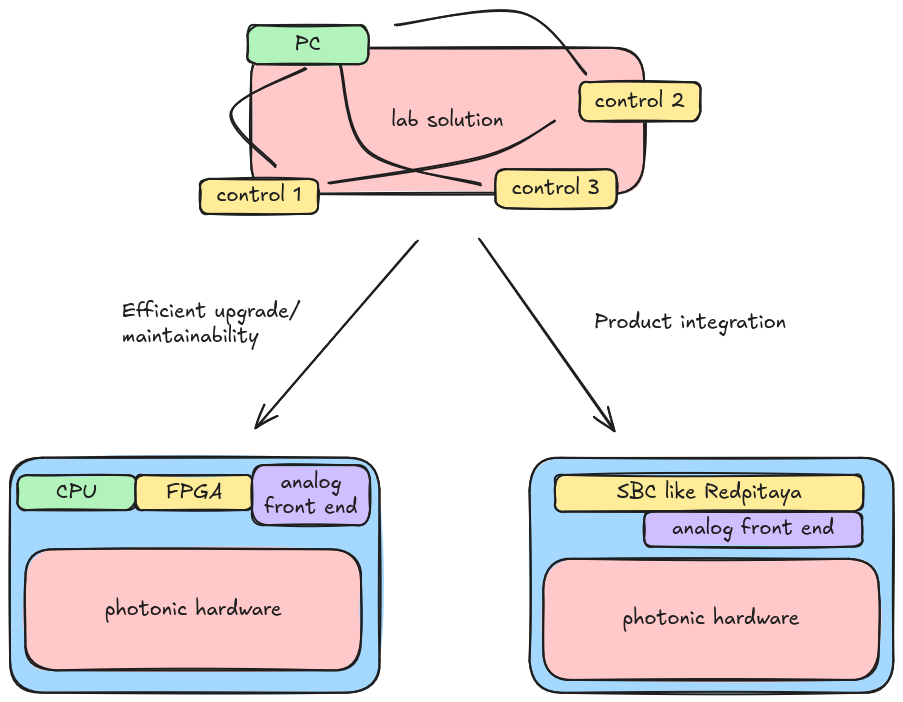
If one considers the needs for an "integrated" system, it is quite clear that there are always three players:
- The CPU: to handle connectivity, configuration, high level programming, etc.
- The FPGA: to handle real time orchestration, high data rate transfers, on-the-fly processing, etc.
- The analog front ends: to condition numerical signals to application specific analog ones
In this vision, most of the "external" wiring between controls becomes "internal" wiring of the FPGA fabric. Connexions between the PC and the controls become numerical bus such as AXI bus in System on Chip devices (such as Zynq devices).
The good thing about this numerical integration is the associated reconfigurability. The bad thing is the steep learning curve to master FPGA SoC handling. The approach of players such as Red Pitaya is to ease this learning curve by providing open source environments with examples and modular reference designs.